



On this page
Forecasting does not fail loudly in Pharma. There is no single moment of collapse, no obvious error you can point to in a review. It fails quietly, through signals that arrived too late, reactions that came after the window closed, and decisions made with just enough uncertainty to matter.
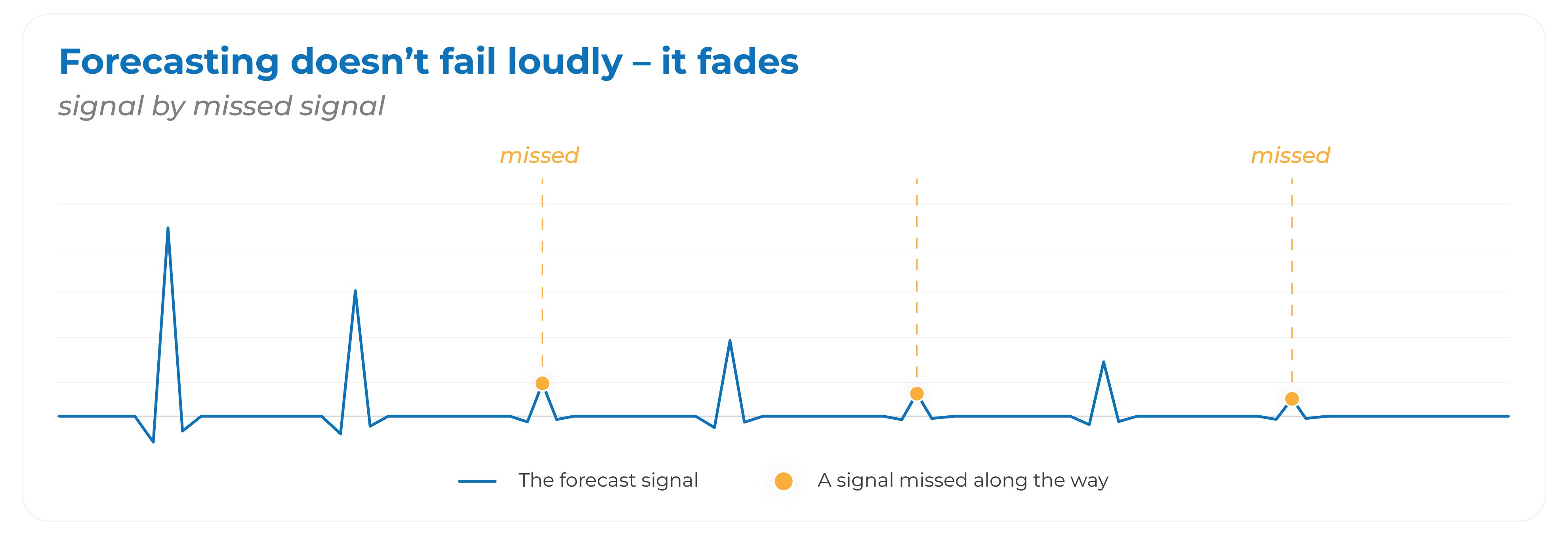
I have sat in enough launch reviews, conversations with forecasting directors, brand leaders and CFOs to say this with confidence: the model is rarely the problem. The operating system around it is.
On paper, most organizations are well-equipped. Models are sophisticated, assumptions are layered, and inputs come from across functions. But in practice, forecasting remains heavier than it should be and more fragile than anyone is comfortable acknowledging.
Spreadsheets continue to anchor critical workflows. Manual adjustments are embedded across the process. Reconciliation cycles become exercises of their own. Over time, teams spend more effort aligning assumptions than understanding what is actually changing in the market.
That gap between how forecasting is designed and how it operates is not new. What has changed is the cost of it.
The commercial environment has shifted in ways that expose the structural limits of how most organizations forecast. Policy shifts do not wait for quarterly cycles. Formulary changes can move access almost overnight. Competitive actions emerge without warning. Patient dynamics evolve in ways that only become visible after they have already influenced demand.
Yet the workflows behind forecasting, manual updates, retrospective analysis, repeated alignment loops, continue to operate at a much slower rhythm than the markets they are meant to reflect.
The result is subtle but consistent. Adjustments become more judgment-driven than signal-driven. Response times stretch. Small inconsistencies compound. And gradually, more organizational energy goes into maintaining the forecast than using it to guide decisions.
This is not a modeling limitation. Teams are not forecasting wrong. They are forecasting within a structure that was built for a world that no longer exists, one where change was slower, more contained, and more predictable.
The operating model has not kept pace. And in a market that moves the way pharma does today, that lag is no longer a manageable inconvenience. It is a strategic liability.
In the next article: why the problem runs deeper than update frequency, and how two fundamentally different speeds of change are pulling traditional forecasting in opposite directions.
What does your forecasting operating model actually cost you?
Share your perspective in the comments, DM Srikanth, or reach out to our team at marketing@customerinsights.ai to continue the conversation.
About this Series
This four-part series is written by Srikanth Kumar Konduri, Forecasting Practice Leader at CustomerInsights.AI. It draws on direct experience working with pharma commercial organizations across launches, budget cycles with brand leaders and CFOs, and supply reviews, as well as the specific forecasting readiness and operating model work CustomerInsights.AI does with those organizations.
If the structural forecasting gap described in this series resonates, whether you're heading into a launch, navigating a competitive shift, or rebuilding a planning process, we'd welcome the conversation.