




On this page
In the previous article, I described how forecasting fails quietly, not through model error, but through an operating system that moves too slowly for the market it is meant to reflect. This article is about why that slowness is structural, not accidental, and why it is getting harder to manage.
The Pharma commercial environment does not change at one speed. It changes at two. And most forecasting operating models were built for only one of them.
The first speed of change is slow and structural. Policy and pricing reforms reshape the market over years, not months. Reimbursement frameworks evolve through regulatory cycles. Epidemiology shifts gradually, and so does the patient population that underpins long-range demand assumptions. These signals require careful interpretation, broader context, and a longer view.
Traditional forecasting was designed for exactly this kind of change. Set assumptions at the start of a planning cycle, update on a defined cadence, revisit when the landscape materially shifts. That structure worked when slow structural change was the dominant signal to absorb.
The second speed of change is different. Formulary decisions can alter access almost overnight. A competitor launch or new indication can redirect physician behavior within weeks. Buy-and-bill dynamics, specialty pharmacy shifts, and channel mix changes move without warning. Near-term inventory behavior can distort how demand appears in the data before anyone has adjusted the model.
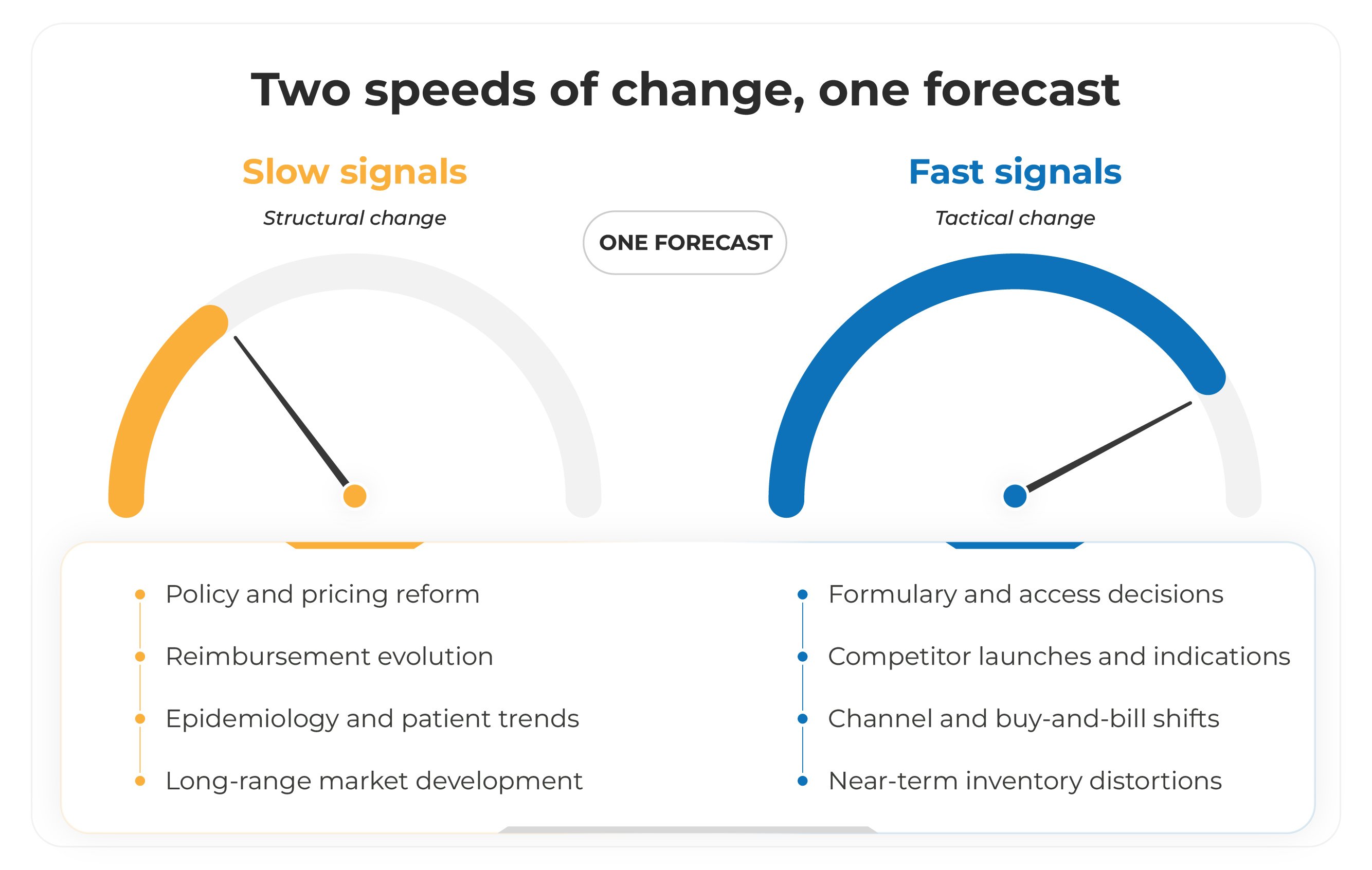 These two speeds of change now coexist inside the same forecast. The same model that tracks a five-year epidemiology curve is expected to reflect a formulary restriction that landed last week. The same quarterly update cycle that works for policy analysis is asked to absorb a competitive entry that changed prescriber behavior in days.
That tension is where most forecasting operating models begin to break down. Not because the models are wrong, but because the rhythm of the system cannot serve both speeds at once.
The consequence is not a failed forecast. It is a forecast that is perpetually slightly behind: current enough to pass review, but not current enough to drive the decision at hand.
Assumptions get set at the start of a cycle and drift quietly out of alignment as the fast signals accumulate. By the time the next scheduled update arrives, the gap has widened. More time goes into catching up than looking ahead. And the question that should be easiest to answer (what changed, and why) becomes harder to answer with each passing week.
Most organizations manage this through judgment. Experienced forecasters carry the context that the model does not formally capture. They know which signals matter, which to discount, and how to adjust for the noise. That institutional knowledge is valuable. But it is also fragile: concentrated in individuals, difficult to scale, and invisible to the governance processes that are supposed to provide oversight.
The real cost of forecasting at a single speed of change when the market moves at two is not inaccuracy. It is the erosion of explainability. When the forecast drifts from reality slowly and informally, it becomes harder to trace why, harder to course-correct with confidence, and harder to build organizational trust in what the number actually means.
In the next article: where these two speeds collide most visibly, and most expensively. Launch forecasting is where structural weaknesses compound at exactly the wrong moment.
Is your forecasting operating model running at one speed or two?
Share your perspective in the comments, DM Srikanth, or reach out to our team at marketing@customerinsights.ai to continue the conversation.
About this Series
This four-part series is written by Srikanth Kumar Konduri, Forecasting Practice Leader at CustomerInsights.AI. It draws on direct experience working with pharma commercial organizations across launches, budget cycles with brand leaders and CFOs, and supply reviews, as well as the specific forecasting readiness and operating model work CustomerInsights.AI does with those organizations.
If the structural forecasting gap described in this series resonates, whether you're heading into a launch, navigating a competitive shift, or rebuilding a planning process, we'd welcome the conversation.