




On this page
In the previous two articles, I described how forecasting fails through structural lag rather than model error, and how most operating models are caught between two speeds of market change they were never designed to serve simultaneously. Both of those problems are present throughout the product lifecycle. But they are most visible, and most expensive, during a launch.
Launch is where everything that was manageable in steady state becomes unmanageable under pressure. The stakes are higher, the data is thinner, and the decisions are irreversible in ways that commercial planning rarely is at other points in the cycle.
The S-curve remains the foundation of launch forecasting for good reason. It captures the general shape of how a new product enters a market: slow initial uptake, accelerating adoption, and eventual plateau. Teams invest weeks aligning on the parameters: peak share, uptake trajectory, time to inflection.
The problem is not the curve. The problem is what happens next.
Within weeks of launch, the assumptions that anchored those parameters begin to drift. Access comes in differently than modeled: not uniformly, but plan by plan, channel by channel. Early prescriber behavior signals something, but it is not yet clear whether it reflects the market or just the noise of initial uptake. A competitor files a new indication. A formulary decision in a key account shifts the access landscape before the first quarterly review.
In the old operating model, the response is a refresh cycle. Teams pull the data, reconcile the inputs, rebuild the curve, realign on assumptions, and present the revised forecast. By the time that process completes, the market has moved again. The forecast is current as of the last alignment meeting, not as of today.
Consider a pattern that plays out more often than most organizations like to acknowledge.
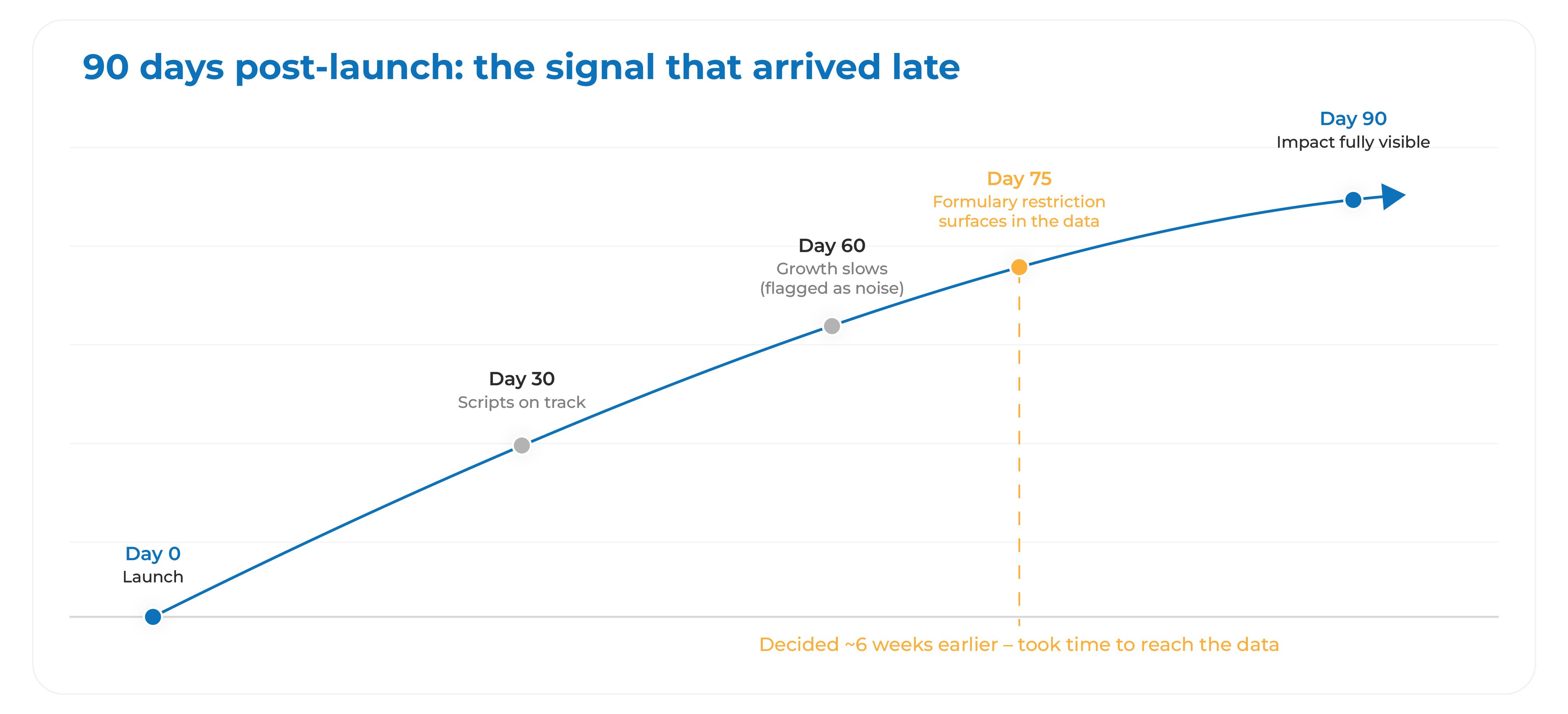
A specialty brand launches with strong physician intent data and a well-modeled S-curve. At day 30, scripts are in line with expectations. At day 60, growth slows. The field team flags it as noise. At day 75, a formulary restriction from a top-three payer surfaces in the data, one that was decided six weeks earlier but took time to propagate through claims.
By the time the restriction is formally incorporated into the forecast, the commercial team has already over-invested in a market access strategy built on the original access assumptions. Contracting resources were allocated, patient support programs were sized, and field deployment was calibrated, all against a forecast that was technically current but practically wrong.
The cost was not a bad model. It was a two-week lag in a signal that was already in the data, unread.
This is not an edge case. It is a pattern. And it repeats because the operating model was not built to surface that kind of signal at the speed the launch window demands.
There is a second failure mode that compounds the first, and it is less often discussed: the erosion of learning.
Launches are the moments when organizations should be accumulating the most knowledge. What drove early uptake? Which access patterns actually predicted share? Where did the analog assumptions hold, and where did they break? That learning is what improves the next forecast, refines the next launch model, and sharpens institutional judgment over time.
But when the operating model is spending its energy on reconciliation and curve-rebuilding, that learning does not accumulate systematically. It lives in the heads of the people who were in the room. It is not captured, not traceable, and not transferable.
The result is that each launch effectively starts from scratch, anchored in analogs and assumptions, but not in the accumulated intelligence of how previous launches actually unfolded in this organization, in this market, against these access dynamics.
The launch window does not extend to accommodate the pace of the operating model. It runs on its own timeline, and the decisions made in the first ninety days on access, on field deployment, on patient support investment are among the most consequential a commercial organization makes. They set the trajectory.
Getting those decisions right requires a forecast that is not just accurate, but current. Not just current, but explainable. And not just explainable in retrospect, but in time to act.
In the final article: what a different operating model actually looks like in practice, and where AI enters the story not as a generic capability, but as a specific solution to a specific structural problem.
When did your launch forecast last reflect what was actually happening in the market?
Share your perspective in the comments, DM Srikanth, or reach out to our team at marketing@customerinsights.ai to continue the conversation.
About this Series
This four-part series is written by Srikanth Kumar Konduri, Forecasting Practice Leader at CustomerInsights.AI. It draws on direct experience working with pharma commercial organizations across launches, budget cycles with brand leaders and CFOs, and supply reviews, as well as the specific forecasting readiness and operating model work CustomerInsights.AI does with those organizations.
If the structural forecasting gap described in this series resonates, whether you're heading into a launch, navigating a competitive shift, or rebuilding a planning process, we'd welcome the conversation.