


On this page
Across the previous three articles, I have described a forecasting problem that is structural rather than technical: an operating model that moves at a single speed in a two-speed market, and that compounds its weaknesses most visibly at launch. This final article is about what a different model looks like, and where AI fits into that picture.
I want to be precise about that last point. "AI in forecasting" has become a phrase that carries almost no information. It has been applied to everything from automated data pulls to experimental language models, and the vagueness has made senior commercial leaders rightly skeptical. So before describing the solution, it is worth naming exactly what problem it is solving.
The core problem is not that forecasters lack data or analytical capability. The problem is that by the time a signal (a formulary change, a competitor move, an access shift) has been identified, interpreted, incorporated into the model, reconciled across functions, and translated into a decision, the window for acting on it has often narrowed significantly.
What is needed is not a smarter model. It is a system that continuously watches the signals that matter, surfaces the ones that require attention, and updates the forecast in a governed, traceable way, so that the human judgment in the room is applied to interpreting the change, not to discovering that it happened.
This is what we mean by Agentic AI in a forecasting context. Not a model that replaces the forecaster. A system that acts on behalf of the forecasting process, continuously monitoring defined signal sources, detecting meaningful deviations from expectations, and triggering structured updates within a governed framework. It does the watching so that the expert can do the thinking.
In practice, this shifts the nature of the work at several levels.
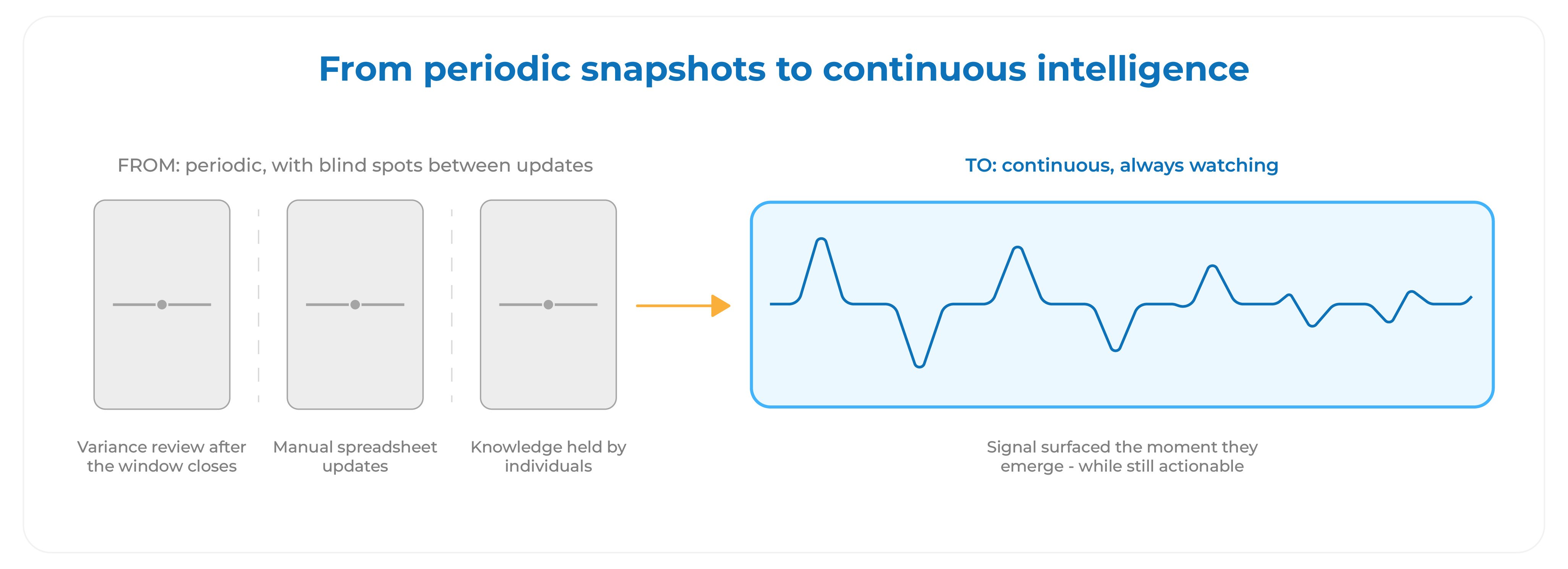
None of these shifts happen because the AI is smarter than the forecaster. They happen because the AI is tireless in a way the forecaster cannot be watching more signals, across more channels, at a frequency no human process can match. The expertise still lives with the people. The system ensures that expertise is applied at the right moment.
There is a prerequisite, and it is worth naming clearly: none of this works without the right data foundation. Demand must reflect true utilization at a meaningful level of granularity. Access dynamics must connect directly to how they manifest in prescribing and channel behavior. Competitive context must be structured to reflect how the market is actually shifting, not just what is publicly visible. Financial constructs must align with how revenue is realized.
Many organizations have invested in better models while leaving the underlying data landscape fragmented. A continuous operating model makes that fragmentation immediately visible because there is no longer a reconciliation cycle to absorb the inconsistencies before they reach the forecast.
Getting the data foundation right is therefore not a prerequisite in the sense of something to defer. It is the work that makes everything else possible.
The organizations that move toward a continuous, signal-driven forecasting operating model do not just forecast more accurately. They make faster decisions, with better-understood uncertainty, at the moments when it matters most. They enter launch reviews with a forecast that reflects what is actually happening in the market, not what was happening when the last update cycle closed. They exit governance conversations with shared understanding rather than competing interpretations of the same number.
More than that, they accumulate learning. Each launch becomes an input to the next. Each signal that was caught early builds the system's pattern recognition. The institutional knowledge that previously lived in individuals begins to live in the operating model itself.
That is what it means to move from periodic updates to continuous intelligence. Not a technology deployment. A different way of operating, one that is finally built for today’s speed of change.
We’ve built this into ciATHENA® - not as a pitch, but because this is the problem I set out to solve.
If you’d like to see how continuous, signal-driven forecasting actually works in practice, DM Srikanth, or reach out to our team at marketing@customerinsights.ai to continue the conversation.
About this Series
This four-part series was written by Srikanth Kumar Konduri, Forecasting Practice Leader at CustomerInsights.AI. It draws on direct experience working with Pharma commercial organizations across launches, budget cycles with brand leaders and CFOs, and supply reviews, and on the specific forecasting readiness and operating model work CustomerInsights.AI does with those organizations.
If the structural forecasting gap described in this series resonates, whether you are heading into a launch, navigating a competitive shift, or rebuilding a planning process, we would welcome the conversation.
Is your forecasting operating model built for today's speed of change, or yesterday's cadence?